People look for image-to-prompt tools for a reasonable reason. You have a picture you like — a room, a product shot, a style — and you want more like it, or you want that exact thing with one change. Reading the prompt out of the image feels like the way in.
So we ran the round trip honestly. Generate an image, describe it as carefully as we could in words, then generate again from the description alone and see what came back.
The original
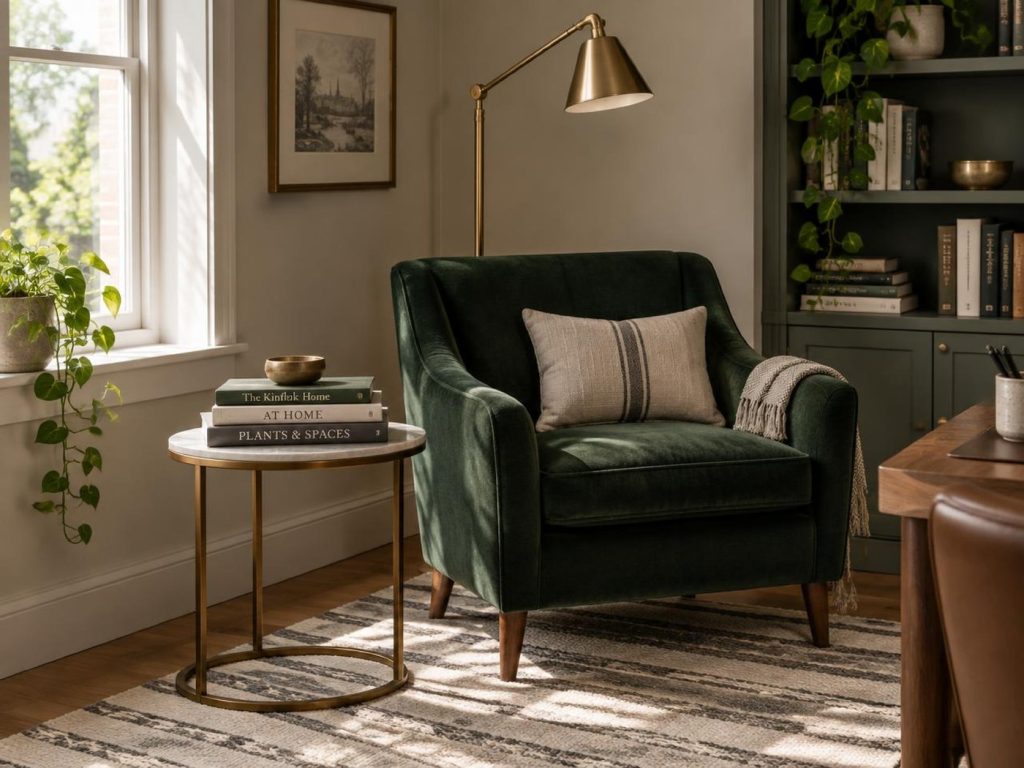
Specific things worth remembering: the side table is round, on the left, with a marble top and thin brass legs. There is a brass bowl on the books. A framed etching of a church hangs on the wall. The cabinet on the right is painted green with ivy trailing over it, and there is a fringed throw over the arm of the chair.
The description
We wrote this to be genuinely good — not a strawman. It is more detailed than most image-to-prompt tools return:
Interior photograph of a cosy home office corner. A dark green velvet armchair sits at an angle facing right. Behind and to its left stands a slim brass floor lamp with a conical shade. To the right of the chair is a small round wooden side table holding a stack of three hardback books. A striped cream and grey rug covers the floor. Warm afternoon daylight enters from a window on the left, casting soft shadows to the right. Neutral painted wall behind. No people, no text.
What came back
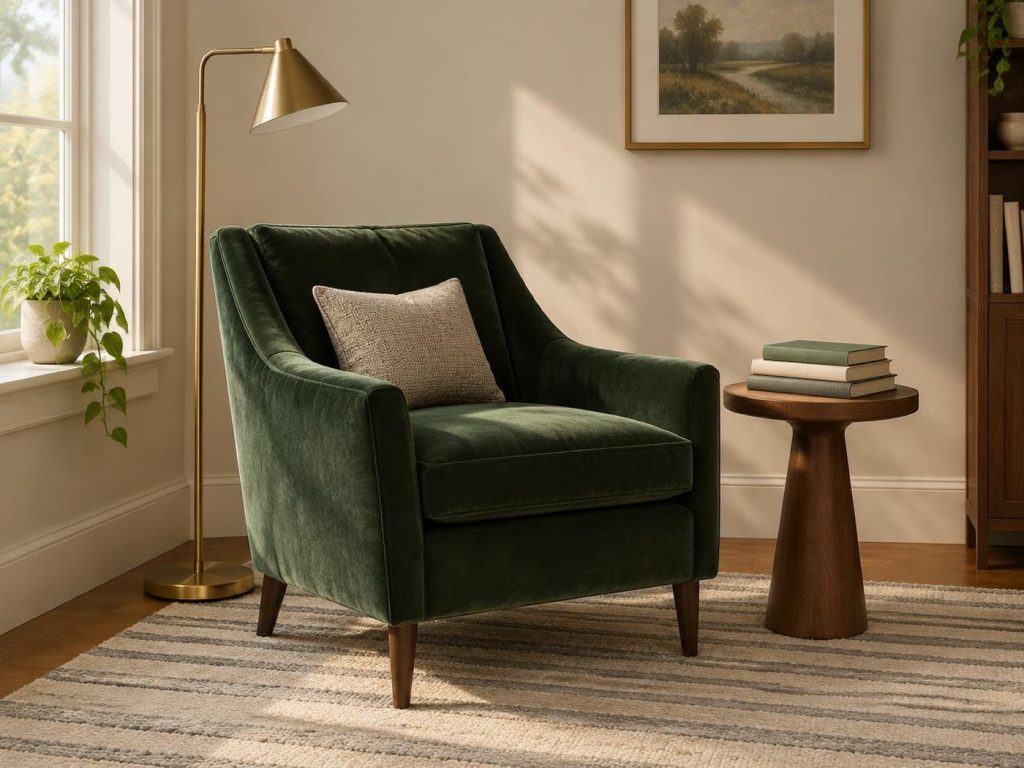
Every ingredient on the list is present. Green velvet chair, brass lamp, three books, striped rug, window on the left, neutral wall. By the standard of “did it follow the prompt”, this is a success.
It is also a completely different room. The side table moved to the other side and turned into a solid walnut pedestal. The lamp came out from behind the chair and stood beside it. The etching became an oil landscape. The green cabinet became a dark wood bookcase. The brass bowl, the throw and the ivy are simply gone. The chair faces the other way.
Why this happens, and why a better description would not fix it
A description names categories. A round wooden side table is a category containing millions of tables. The image is one specific member of that category, and the words carry no way of pointing at which one.
You could go further — “marble top, three thin tapered brass legs joined by a ring at the base” — and the table would get closer. But now do that for the lamp, the rug’s stripe rhythm, the exact green of the cabinet, the angle of the light, the shadow shape on the wall, the ivy. Somewhere in there the description stops being a prompt and starts being a worse copy of the image you already have.
Everything you do not pin down gets re-rolled. You cannot pin down everything. That is the whole ceiling on this approach, and it is not a quality problem you can prompt your way past.
The alternative: do not convert it to words at all
If what you want is that room, with one change, the words are the wrong medium. Hand over the image itself with the change attached — editing image to image rather than image to prompt to image. Then “make it evening” means this room at a different hour, not a different room at a different hour.
The table stays where it is, because nobody asked about the table.
When image-to-prompt is genuinely the right tool
It has real uses, and they are not the one most people search for:
- Learning vocabulary. You like a look and cannot name it. A description gives you the terms to reuse deliberately.
- You cannot reuse the image. Someone else’s photograph, or one you have no licence to feed anywhere. A description you wrote is yours.
- Your destination only takes text. Some tools have no image input at all. Then words are all you have.
- You want the genre, not the instance. “Something in this vein” is exactly what a description is good for.
The limit worth stating
Working from the image instead of a description does not make everything reproducible either. Ask for a big change — a different room, a different style — and you are back to re-rolling, because you have asked for it. The image-based route protects what you did not mention. It cannot protect what you told it to replace.
And if the original is not yours to use, no workflow makes it yours. That part is a rights question, not a tooling one.
Start with 300 free credits — no card required